
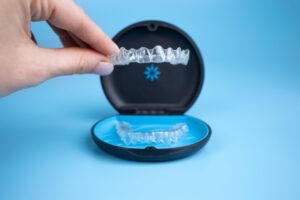
If you already have dental work like crowns, bridges, fillings, or implants, you may wonder whether you can still straighten your teeth with Invisalign. The good news is that many people with dental restorations are still excellent candidates for clear aligner treatment.
However, your dentist or orthodontist will need to carefully evaluate your smile to determine the best approach.
How Invisalign Works with Restorations
Invisalign uses a series of custom-made clear aligners to gradually move teeth into better positions. Since the aligners fit over your teeth, many types of restorations can work well alongside treatment.
Common restorations that may still allow for Invisalign include:
- Tooth-colored fillings.
- Dental crowns.
- Veneers.
- Dental implants.
- Bridges.
Each case is unique, so the type, condition, and location of your restorations all matter.
Crowns and Fillings
Crowns and fillings generally do not prevent Invisalign treatment. Teeth with crowns can usually move just like natural teeth.
However, your dentist may need to take extra care when attaching small alignment accessories called attachments to crowned teeth. These attachments help guide tooth movement during treatment.
As long as your crowns and fillings are healthy and secure, Invisalign is often still a good option.
Dental Implants
Dental implants are different because they are permanently fused to the jawbone and cannot move like natural teeth.
This means Invisalign cannot reposition the implant itself. However, surrounding natural teeth can still be moved around the implant to improve alignment and bite function.
Your treatment plan will be designed with this limitation in mind.
Bridges and Veneers
Bridges can sometimes make treatment more complex because connected teeth may not move independently. Veneers, especially older or fragile ones, may also require careful handling to avoid damage during treatment.
Your dentist will evaluate whether adjustments or additional precautions are needed before beginning Invisalign.
The Importance of Oral Health First
Before starting Invisalign, your dentist will ensure your teeth and gums are healthy. Problems such as gum disease or untreated decay should be addressed first to ensure successful tooth movement and long-term results.
Healthy supporting structures are essential for safe orthodontic treatment.
Benefits of Invisalign with Restorations
For many patients, Invisalign can actually improve the function and appearance of existing dental work by creating a more balanced bite and better tooth alignment.
Straight teeth are also easier to clean, which can help protect crowns, veneers, and other restorations from future problems.
Having dental restorations doesn’t automatically disqualify you from Invisalign treatment. Many people with crowns, fillings, veneers, or implants can still achieve a straighter smile with the right treatment plan. The best way to find out if you’re a candidate is to schedule a consultation with your dentist or orthodontist. They can evaluate your existing dental work and create a customized plan designed to protect your restorations while improving your smile.
About the Author
Dr. Stacy Hebert-Schoener earned her D.D.S. at the University of Texas Dental Branch in Houston. She then completed a residency at Memorial Hermann Hospital that focused on caring for medically complex patients, trauma-related dentistry, and anesthesia. Always learning, Dr. Hebert-Schoener is an active member of the American Dental Association, the Texas Dental Association, and the Greater Houston Dental Society. If you’d like to achieve a straighter, healthier smile with Invisalign, let us know! Book an appointment online or call our Bellaire office at (713) 666-1597.